
Published: 2025 | Category: Hermès Colors | Reading Time: ~12 minutes
Introduction to Hermès Origan Color
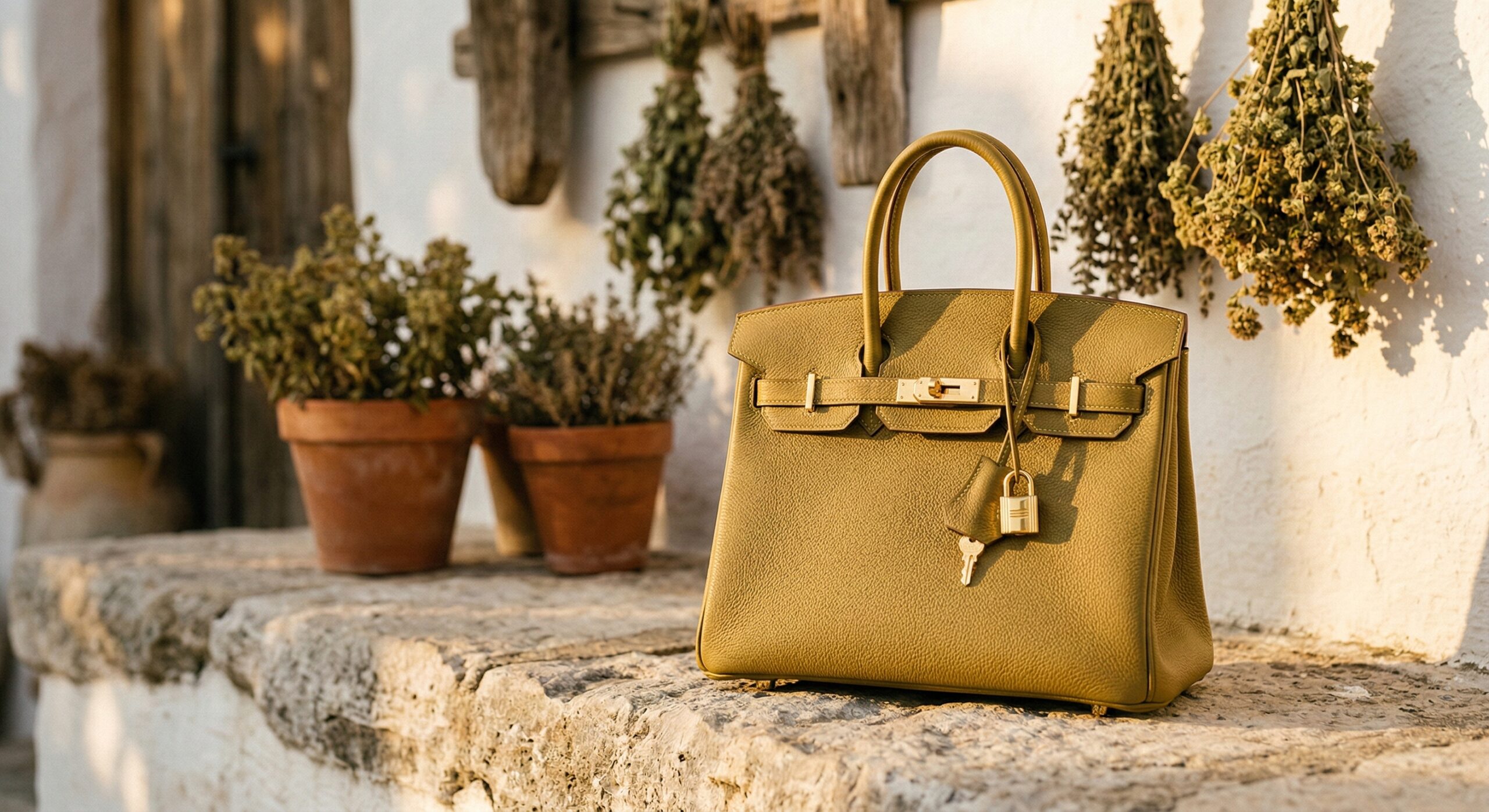
Hermès Origan stands as one of the most aromatically evocative and culinarily rooted entries in the luxury house’s celebrated color library. Named after origan — the French word for oregano, the pungent Mediterranean herb whose dried leaves carry one of the most universally recognized culinary fragrances in the world — Origan is a green of exceptional warmth, earthiness, and herbal complexity. It captures the specific quality of dried oregano: a muted, warm, yellow-inflected green that carries within it the sun-drenched hillsides of the Mediterranean, the stone walls of Greek and Italian herb gardens, and the extraordinary sensory richness of a culinary tradition stretching back to antiquity.
What distinguishes Origan from the broader spectrum of Hermès greens is its particular quality of herbal warmth — a muted, earthy, yellow-green that occupies the productive territory between green and olive, between botanical and culinary, between the living herb and its dried and concentrated form. This is not a fresh spring green or a deep forest green; it is the green of herbs under the Mediterranean sun, slightly faded by heat and light into a color of extraordinary warmth and sensory richness. Origan is a green that one can almost smell as well as see — a color that engages the full sensory imagination in a way that more conventionally beautiful greens do not.
The History of Hermès Origan Color
The origins of Origan reflect Hermès’ tradition of reaching into the culinary and herbal world for color names that engage the full sensory imagination rather than merely the visual sense. Oregano — Origanum vulgare — has been one of the most important and most culturally embedded herbs in the Mediterranean culinary and medicinal tradition for more than three thousand years. The ancient Greeks used it medicinally and ceremonially; the Romans spread it across their empire wherever they conquered; in modern Mediterranean cooking, from Greece to Italy to Spain to the Middle East, it remains one of the defining aromatic herbs of an entire culinary civilization.
The specific color of dried oregano — a warm, muted yellow-green that is neither the bright green of fresh herbs nor the grey-green of some other dried herbs but something more golden and more earthy — has been present in Mediterranean visual culture for millennia. It is the color of the dried herb bundles that hang in the kitchens of Greece and southern Italy, of the hillside scrub that covers the limestone mountains of the Mediterranean basin, of the pressed herbs in the apothecary’s cabinet. In naming a leather color for this herb, Hermès connects its goods to a sensory tradition of extraordinary cultural depth and breadth.
In the broader context of Hermès color history, Origan sits within the house’s rich tradition of culinary and herbal naming — a tradition that includes spice colors like Curcuma and herbal colors like Vert Sage, demonstrating the house’s understanding that the most compelling colors often engage not just vision but the full sensory memory of smell, taste, and touch. Among these, Origan occupies a uniquely warm and earthy position — a herbal green that leans into olive and khaki territory, bridging the gap between the botanical world of pure greens and the culinary world of warm, sun-dried plant material.
Characteristics of Hermès Origan Color
Visual Properties
Origan possesses a distinctive constellation of visual characteristics that set it apart across all Hermès greens:
- Base Tone: A warm, muted yellow-green with olive inflections that give it its defining herbal, sun-dried character — a green that sits firmly in the warm, earthy zone of the spectrum, referencing the specific color of dried oregano in Mediterranean sunlight
- Undertones: Warm yellow-gold and brown undertones that give Origan its defining earthy quality — preventing it from reading as a conventional green and placing it instead in the rich, complex territory between green, olive, and warm earth
- Depth: Medium value that gives Origan both visual substance and wearable accessibility — deep enough to possess genuine chromatic authority, warm enough to feel naturally compatible with a broad range of neutral and earth tone companions
- Earthiness: A distinctly earthy, grounded quality that connects this color to the Mediterranean landscape rather than to any conventional luxury green tradition — the color of stone walls and dried herbs rather than formal gardens
- Complexity: A multidimensional warmth that causes Origan to reveal different aspects — more yellow in certain lights, more green in others, more brown in warm incandescent settings — giving it the sensory richness of the herb that inspires it
The color’s behavior under different lighting conditions reflects its herbal, Mediterranean character with remarkable fidelity. In warm natural daylight, particularly in the strong, direct sunlight of the Mediterranean summer, Origan reveals its warmest, most golden character — the yellow undertones glowing with the specific quality of dried herbs in sunlight. Under softer, more diffuse light, the green aspect becomes more apparent, the color reading as a more clearly green-olive. Under incandescent light, the warm brown undertones emerge most strongly, giving Origan an intimate, almost culinary richness that recalls the warm light of a Mediterranean kitchen.
How Origan Appears on Different Leathers
The visual impact of Hermès Origan varies significantly depending on the leather type:
- Togo Leather: The pebbled grain of Togo adds organic texture that gives Origan a naturalistic, earthy quality perfectly suited to its herbal character — the surface variation creating the visual impression of texture that recalls dried herb bundles
- Epsom Leather: On Epsom’s structured surface, Origan appears at its most composed and contemporary — the regular texture giving the warm herbal green a graphic precision that bridges the botanical and the architectural
- Swift Leather: The smooth surface of Swift allows Origan’s warm yellow undertones to express themselves most clearly, the color reading with the even, dry warmth of sun-dried herbs on a stone surface
- Clemence Leather: Soft Clemence gives Origan its most relaxed, organic expression — the warm herbal green softened by the leather’s gentle surface variation into something that recalls the living texture of a Mediterranean herb garden
- Box Calf: On Box calf’s polished surface, Origan acquires an unexpected refinement — the warm herbal green elevated by the leather’s sheen into something that bridges the earthy and the luxurious with particular elegance
- Chevre Mysore: The fine goatskin renders Origan with exceptional evenness and a warmth that gives the color its most intimately herbal character — the earthy yellow-green reading as both botanical and richly personal
Color Pairings and Versatility
Hermès Origan offers distinctive versatility built around its warm herbal Mediterranean character:
- Earth Tone Family: Pairs with exceptional naturalness alongside terracotta, warm brown, camel, and sand — the herbal green’s warm yellow undertones connecting it harmoniously to earth tones in compositions that recall the full palette of the Mediterranean landscape
- Neutral Foundation: Works beautifully with Etoupe, warm grey, and cream — the herbal green providing a botanical accent that animates neutral compositions without disrupting their fundamental restraint
- Spice Companions: Creates particularly resonant pairings with warm spice tones — ochre, curcuma, terracotta — the herbal and spice color families sharing the same culinary and sensory heritage
- Noir Contrast: Against Noir, Origan reads as a sophisticated botanical statement — the warm herbal green providing unexpected depth and complexity against the absolute authority of black
- Hardware Considerations: Gold hardware creates the most harmonious and most naturally Mediterranean pairing — the warm metal echoing the golden undertones of the dried herb; palladium offers a cooler, more contemporary contrast that emphasizes the green aspect
Fashion stylists describe Origan as a “sensory neutral” — a color that functions with the wardrobe flexibility of an earth tone while delivering considerably more chromatic interest and botanical specificity. Its warm, muted character prevents it from asserting itself aggressively, while its herbal complexity ensures it is never merely background. This dual quality makes Origan particularly compelling for collectors who want a green that wears with the ease of a neutral while rewarding the attentive eye with genuine botanical character.
Origan in Hermès Collections
Popular Hermès Bags in Origan
Origan has graced many of Hermès’ most iconic bag silhouettes, the color’s warm herbal earthiness lending each design a quality of natural, Mediterranean-inspired distinction:
- Birkin: In Origan, the Birkin achieves a quality of warm, grounded naturalness that is entirely its own — the herbal green giving the silhouette an organic presence that feels simultaneously distinctive and deeply wearable across all sizes
- Kelly: The Kelly’s architectural structure takes on a warm, earthy distinction in Origan — the formal geometry of the bag softened by the color’s herbal warmth into something that bridges high formality and natural ease
- Constance: On the compact Constance, Origan delivers concentrated herbal sophistication — the warm yellow-green perfectly scaled to the bag’s compact format, with gold hardware creating a particularly evocative Mediterranean pairing
- Lindy: The relaxed Lindy in Origan has a quality of natural, comfortable warmth — the bag’s casual character and the herbal green’s earthy accessibility creating a combination of genuine everyday luxury
- Garden Party: The Garden Party tote in Origan is an especially natural combination — the bag’s connection to outdoor settings finding perfect chromatic expression in a color that references the sun-drenched herb gardens of the Mediterranean
- Picotin: In Origan, the open Picotin achieves an extraordinary connection to its own market-basket origins — the herbal green and the utilitarian form creating a combination that is genuinely, unpretentiously beautiful in its botanical honesty
Beyond Bags: Origan in Other Hermès Products
Origan’s warm herbal character translates beautifully across the full range of Hermès product categories:
- Small Leather Goods: Wallets, cardholders, and agenda covers in Origan carry the color’s herbal warmth in everyday format — a daily encounter with the botanical richness of the Mediterranean world in the most intimate of everyday objects
- Silk Scarves and Twillys: Origan finds natural expression in Hermès silk designs featuring botanical, Mediterranean, or culinary motifs — the warm herbal green providing an earthy, authentic ground for compositions that reference the natural and culinary world
- Belts and Accessories: Origan belts with gold hardware create warm, botanically grounded accessories that bring the Mediterranean herbal palette to any ensemble as a finishing element of genuine distinction
- Ready-to-Wear: Selected seasonal collections have featured Origan in leather and suede pieces where its herbal warmth creates a quietly distinctive, naturally Mediterranean aesthetic
- Home Collection: In leather-trimmed home goods and decorative objects, Origan brings the sensory richness of the Mediterranean kitchen and herb garden to interior settings — particularly resonant in dining rooms, kitchens, and spaces that celebrate the culinary arts
- Watches and Accessories: The color has appeared in strap options across Hermès watch collections, where its earthy herbal character creates naturally versatile pairings with both casual and semi-formal watches
Collector Appeal of Hermès Origan Color
Rarity and Market Value
Origan occupies a compelling position in the hierarchy of Hermès collector desirability. As a seasonal, limited-production color of exceptional herbal specificity, it carries genuine rarity — and its particular character as a warm, muted, earth-inflected green means it appeals to a collector audience that extends beyond those who typically seek out botanical greens. The color’s neutrality-adjacent warmth attracts collectors drawn to the productive territory between true color and true neutral — the zone where the most wearable and most enduringly interesting Hermès colors consistently live.
Auction houses and luxury resellers have noted several consistent patterns in the Origan market:
- Neutral-Adjacent Premium: Origan’s warm, earthy character gives it the wearability of a neutral while the herbal specificity rewards collectors who seek colors with genuine botanical depth — this dual quality creates consistent demand from both neutral-focused and botanical-focused collectors
- Condition Resilience: As a medium-value, warm-toned color, Origan is more forgiving of minor surface changes than lighter or more saturated colors — good examples are broadly desirable and pristine examples command meaningful premiums
- Leather Versatility: Origan performs strongly across virtually all leather types — the warm herbal character adapting naturally to textures from smooth to pebbled with consistent appeal
- Hardware Preference: Gold hardware examples consistently command the strongest collector interest, the warm metal and herbal green creating the most cohesive and most evocative Mediterranean expression
- Cross-Collector Appeal: Origan attracts collectors across the green, earth tone, and neutral-seeking spectrum, creating broader secondary market demand than more directional greens
Authentication Aspects of Origan
For collectors and authentication experts, Origan presents specific characteristics that assist in verifying authentic Hermès pieces:
- The color’s distinctive warm yellow-green balance is difficult to replicate — counterfeits typically appear as either a flat olive green without the herbal warmth, or as a conventional green-yellow without Origan’s specific earthy, dried-herb quality
- Under natural light, authentic Hermès Origan displays warm golden undertones that give the green its defining herbal character — a quality specific to Hermès’ dye formulation that prevents the color from reading as a generic olive
- The warm-cool balance should shift perceptibly between different lighting conditions — more golden in warm light, more clearly green in cool light; a color that appears identical under all lighting conditions lacks the complexity of authentic Origan
- On genuine pieces, the color maintains consistent warmth and evenness across the entire surface, with the leather’s natural grain visible beneath the dye
- Authentic Origan on natural leathers develops a specific warming of its yellow undertones over time, the herbal character deepening gracefully as the leather ages
Caring for Hermès Origan Leather
Color Preservation
Maintaining the warm herbal character of Origan requires thoughtful, leather-specific care:
- UV Protection: As a warm, yellow-inflected green, Origan is sensitive to prolonged UV exposure, which can gradually shift the balance between the yellow and green aspects of the color; store away from direct sunlight to preserve the defining herbal warmth
- Color Transfer Awareness: Origan’s medium value and warm tone give it moderate color transfer risk — take appropriate precautions with very light-colored clothing, particularly in warm conditions
- Moisture Management: Protect from rain and moisture; water marks are visible against the even surface of this color and can alter the warm-cool balance in ways that may require professional attention
- Regular Maintenance: The warm, earthy character of Origan is best maintained through consistent, gentle care — regular cleaning and periodic conditioning preserve both the leather’s integrity and the color’s herbal warmth
- Storage: Store in the original Hermès dust bag in a cool, dark, dry location — standard fine leather storage conditions are ideal for preserving this warm, complex color over time
Cleaning and Maintenance
Specific care recommendations for Origan items include:
- Store in the original Hermès dust bag away from direct light — UV protection is the most important long-term care factor for preserving Origan’s defining herbal warmth
- Clean regularly with a soft, dry cloth to remove surface dust and prevent accumulation that can gradually alter the color’s warm character
- Address moisture exposure promptly and gently; allow to air dry naturally at room temperature away from any heat source
- Condition periodically with leather conditioner approved for fine leather goods — conditioning maintains surface integrity and helps preserve the warm-green balance that defines Origan
- For significant cleaning, color refreshment, or any concern about the warm-cool balance, consult Hermès’ own spa and repair service for color-specific professional care
Origan Compared to Other Hermès Colors
Understanding Origan’s precise position in the Hermès color universe requires comparing it to its closest relatives:
- Vert Criquet vs. Origan: Vert Criquet (cricket green) is a brighter, more vivid warm green that sits at a lighter, more clearly green value than Origan — where Criquet has the fresh warmth of summer grass, Origan has the dried, concentrated warmth of preserved herbs, the two sharing a yellow-green direction but at very different levels of saturation and dryness
- Vert Sage vs. Origan: Vert Sage (sage green) is a silvery, grey-inflected herbal green that shares Origan’s Mediterranean botanical reference but leans cool and silvery where Origan leans warm and golden — two herbs from the same Mediterranean hillside but expressing entirely different aspects of the botanical color world
- Kakhi vs. Origan: Kakhi is warmer and more brown-yellow, leaning further from green and further toward the sandy earth tones of open landscape — where Kakhi is primarily an earth color with green influence, Origan is primarily a green with warm earth influence, the two sharing a zone of the color spectrum but with different primary identities
- Vert Amande vs. Origan: Vert Amande (almond green) is lighter, softer, and more delicately botanical than Origan — a pale, gentle green without Origan’s earthy warmth and herbal concentration; where Amande is fresh and delicate, Origan is warm and deeply botanical
- Vert Mangrove vs. Origan: Vert Mangrove is a deep, cool, blue-inflected green at the opposite end of the botanical temperature spectrum from Origan — where Mangrove references the cool, aquatic depth of a coastal tropical ecosystem, Origan references the warm, dry, aromatic world of Mediterranean herb gardens
- Etoupe vs. Origan: Etoupe is the quintessential warm grey-taupe neutral — a color that has fully crossed from green-grey into pure warm neutral territory; Origan retains a clearly green identity within its warmth, sitting at the border between green and neutral rather than having crossed it as fully as Etoupe has
The Cultural Significance of Hermès Origan Color
Oregano’s Mediterranean Heritage
The cultural significance of Origan is inseparable from oregano’s extraordinary history as one of the defining herbs of Mediterranean civilization. Oregano — whose name derives from the Greek oros ganos, meaning “joy of the mountains” — has been woven into the fabric of Mediterranean life for more than three thousand years. The ancient Greeks used it medicinally to treat wounds and respiratory conditions, ceremonially in the crowns placed on newlyweds as symbols of happiness, and culinarily as a seasoning for meat and fish. The Romans adopted it enthusiastically and spread its cultivation throughout their empire, carrying the herb and its characteristic color and fragrance across Europe and into the Middle East.
The herb’s connection to joy and happiness — embedded in its very name — gives Origan the color a layer of etymological warmth that enriches its already considerable sensory resonance. A color named for the “joy of the mountains” carries within it not only the visual memory of Mediterranean herb gardens but the full cultural heritage of a plant that has represented happiness, hospitality, and the pleasures of the table across three millennia of human civilization. This depth of cultural association is precisely what distinguishes the greatest Hermès color choices from merely beautiful colors.
In Contemporary Fashion Context
In contemporary fashion, Origan occupies a specific and increasingly resonant position as part of the broader movement toward what might be called “culinary color” — colors that reference the sensory world of the kitchen, the herb garden, and the table rather than the more conventional luxury references of gemstones, precious metals, or formal botanical gardens. This movement, driven by growing consumer interest in authenticity, provenance, and the pleasures of the everyday made luxurious, places Origan exactly where the most discerning contemporary luxury taste has been moving.
Fashion observers note that warm, muted, earth-adjacent greens in the olive and herbal register have experienced significant collector appreciation as part of the broader movement toward colors that function as sophisticated neutrals while delivering genuine botanical character. In this context, Origan’s specific herbal reference positions it as one of the most naturally wearable and most culturally resonant green choices in the current Hermès palette.
Styling Hermès Origan Color
Personal Styling Recommendations
Fashion experts offer several approaches to maximizing the impact of Origan pieces:
- The Mediterranean Palette: Build a wardrobe composition around Origan and its natural Mediterranean companions — terracotta, warm sand, ivory, and gold — for a richly atmospheric palette that captures the full warmth of the southern European color world
- The Earth Tone Anchor: Use Origan as the botanical anchor of an earth tone palette — the herbal green providing the single chromatic note that connects warm neutrals to the natural world with genuine botanical specificity
- The Neutral Bridge: Pair Origan with Etoupe, warm grey, and cream for compositions that demonstrate the color’s exceptional neutrality-adjacent character — the herbal green functioning almost as a warm neutral while delivering more chromatic interest
- Autumn Excellence: Origan achieves its fullest and most natural expression in autumn contexts — the warm herbal green connecting to the season’s own palette of dried herbs, golden light, and warm earth tones with complete chromatic harmony
- The Sensory Statement: For collectors who value colors that engage the full sensory imagination, Origan is a uniquely compelling choice — a color whose full meaning is revealed not only by looking but by knowing, connecting visual beauty to aromatic memory and cultural heritage
Interior Design Crossover
Origan’s warm herbal character has made it a natural and beloved reference in sophisticated interior design:
- As a leather accent in Mediterranean-inspired interiors — spaces that celebrate warm stone, terracotta, aged wood, and the sensory richness of southern European design — where Origan’s herbal warmth creates authentic botanical connections
- In kitchen and dining room settings where the color’s culinary reference creates an appropriately warm, appetite-stimulating, and convivially inviting atmosphere
- Paired with terracotta, warm sand, aged brass, and natural linen — the material companions of Mediterranean interior design that share Origan’s warm, sun-drenched character
- In library and study spaces where the botanical and historical depth of the herb reference creates a quietly erudite atmosphere of accumulated natural knowledge
- In any interior that benefits from the specific quality of warmth that a muted, earthy herbal green provides — grounding spaces with botanical honesty while warming them with herbal richness
Origan in the Context of Hermès Color Evolution
Origan illustrates several key principles of Hermès’ approach to color development:
- Culinary Color Heritage: In naming a color for a specific culinary herb, Hermès extends its botanical vocabulary into the sensory world of the kitchen — a world with its own deep color traditions and its own powerful connections to pleasure, culture, and memory
- Multisensory Naming: Origan demonstrates Hermès’ understanding that the most resonant color names engage multiple senses — a color named for a fragrant herb evokes not just visual memory but aromatic memory, creating a more complete and more deeply personal color experience
- The Warm Green Frontier: Origan pushes the Hermès green family into the specifically warm, dried-herb territory — expanding the palette’s botanical range into chromatic and sensory territory that more conventionally beautiful greens do not explore
- Etymology as Depth: The oregano name’s Greek etymology — “joy of the mountains” — adds a layer of meaning that transforms a beautiful color into a named embodiment of happiness, connecting Hermès’ craft to one of the most ancient and most human of aspirations
- Investment Wearability: Colors that function as sophisticated neutrals while delivering genuine botanical character have historically shown strong secondary market performance — Origan’s herbal warmth gives it the wearability of an earth tone with the collector interest of a distinctive botanical color
Conclusion: The Aromatic Joy of Hermès Origan
Hermès Origan color represents one of the most sensorially rich and culturally layered entries in the luxury house’s color history. Named for the “joy of the mountains” — an herb whose three-thousand-year presence in Mediterranean life connects it to the deepest traditions of human pleasure, hospitality, and celebration — realized through the exceptional dye craft that produces its defining warm herbal character, Origan offers collectors and enthusiasts something genuinely rare: a luxury color that engages not just the eye but the full sensory imagination, connecting visual beauty to aromatic memory and cultural heritage in a single, warm, beautifully muted green.
For collectors, Origan represents one of the most naturally wearable and most botanically specific additions to any Hermès collection — versatile enough to function as a sophisticated neutral across virtually every context and season, specific enough to carry genuine herbal and cultural meaning for those who know its story, and warm enough to feel immediately right in a way that more exotic or more saturated greens often do not. Its Mediterranean herbal warmth brings a quality of quiet, grounded joy to any ensemble that no other green in the Hermès palette quite replicates.
In a world where luxury goods often pursue impact through rarity and novelty, Origan stands as evidence of Hermès’ mastery of a more intimate and more enduring register — the luxury of a color that connects to everyday pleasure, to the sensory richness of the natural world, to the specific warmth of an herb that has been bringing joy to human life for three thousand years. In acquiring a piece in this distinguished color, one does not merely choose a green bag — one carries with them a small, portable piece of Mediterranean joy.